

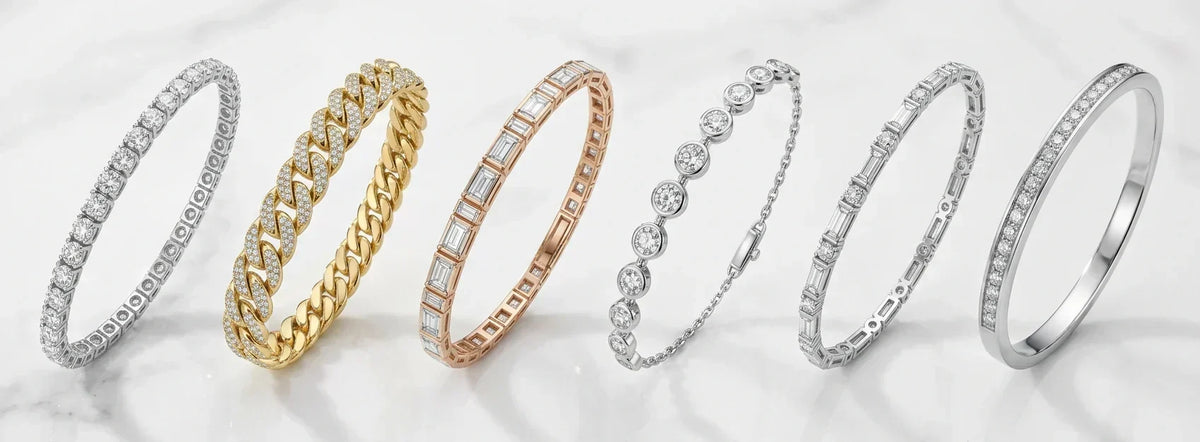
Diamond Bracelet Types: Tennis, Cuban, Baguette & More
From the quiet brilliance of a classic tennis bracelet to the bold architecture of a diamond Cuban link, the finest bracelets balance craftsmanship, diamond quality, and timeless design.
A bracelet can be one of the most expressive pieces in a fine-jewelry collection. Unlike a ring, which often carries deeply personal symbolism, or a necklace, which naturally becomes a focal point, a bracelet has a certain ease. It moves with the wrist, catches light almost incidentally, and reveals its character gradually.
That versatility has made the diamond bracelet a lasting fixture in fine jewelry. Yet the category extends far beyond the familiar tennis bracelet. Round diamonds, baguette cuts, emerald cuts, Cuban links, bangles, flexible designs, and mixed-facet arrangements each create a distinct impression.
For those seeking genuine fine jewelry, the distinction goes deeper than appearance. The diamonds, precious metal, setting technique, construction, and craftsmanship all shape a bracelet's character and long-term quality.
At Dayyani Jewelers, where natural diamonds, precious metals, gemstones, and in-house jewelry manufacturing have been central to the business since 1992, that distinction matters. The right bracelet is not simply a matter of sparkle. It sits at the intersection of design, gemology, craftsmanship, and personal significance.

The Timeless Charm of the Diamond Bracelet
Fine bracelets have long held a distinctive place in jewelry. They can be understated enough for everyday wear while still carrying the presence expected of an important piece of fine jewelry.
Diamonds add another dimension. Because a bracelet is viewed from many angles as the wrist moves, diamonds can produce a constantly changing interplay of brightness and scintillation. The effect is particularly pronounced in designs where stones are arranged closely together or positioned to capture light across the entire circumference.
But not every diamond bracelet creates the same kind of brilliance.
A tennis bracelet, for example, emphasizes continuity. A Cuban bracelet emphasizes scale, structure, and the relationship between diamonds and gold. A baguette diamond bracelet introduces geometric lines and the distinctive character of step-cut diamonds. A bangle may provide a more architectural silhouette, while a mixed-shape bracelet can combine several visual languages in one piece.
Understanding those differences makes the category more interesting and makes it easier to recognize the craftsmanship behind an exceptional piece.
Tennis Bracelet: The Classic Line of Diamonds
The tennis bracelet is one of the most recognizable diamond bracelet styles. It traditionally features a continuous row of individually set diamonds linked by flexible connectors, allowing it to move naturally with the wrist while maintaining a seamless line of stones.
Its name has a memorable origin: during the 1987 U.S. Open, tennis star Chris Evert paused her match after her diamond bracelet's clasp broke and the bracelet slipped off her wrist. The incident drew widespread attention, and the term "tennis bracelet" became associated with this type of diamond line bracelet.
However, the design itself predates that event. The appeal of a tennis bracelet lies in its simplicity: instead of a large central stone, it spreads diamonds across the entire wrist. This can create a very elegant look in a slender form or a bolder impression with larger stones. Dayyani's collection shows this versatility, offering both delicate tennis bracelets and designs with larger round diamonds in rose gold, white gold, yellow gold, and alternative diamond shapes.

Emerald Shaped with Round Diamond Tennis Bracelet Shop Now |

Diamond Tennis Bracelet with Red Ruby Shop Now |

5-Pointer Rose Gold Diamond Tennis Bracelet Shop Now |
What Makes a Tennis Bracelet Exceptional?
A tennis bracelet requires consistency. Because multiple diamonds sit side by side, variations in color, size, cut quality, or overall look can become obvious. A skillfully crafted bracelet maintains unity throughout. The setting is crucial too. It should offer both flexibility and security, and GIA recommends regular checks of the clasp, safety catch, and mountings, especially since the bracelet is meant to move.
The diamonds also need careful selection. For round brilliant cuts, the cut greatly influences appearance. GIA's grading system rates these diamonds from Excellent to Poor, based on brightness, fire, scintillation, proportions, durability, polish, and symmetry. Therefore, carat weight alone doesn't fully describe a diamond bracelet's quality.

Cuban Diamond Bracelet: Bold Gold and Diamond Presence
While the tennis bracelet is defined by continuity, the Cuban bracelet is defined by structure. Cuban link bracelets feature interlocking links that create a bold, sculptural look. Adding diamonds balances the visual weight of precious metal with the sparkle of gemstones.
This style is among the most distinctive in modern diamond bracelets, especially when the links are wide enough to create a strong, architectural silhouette. Proportions matter: a narrower Cuban bracelet looks sleek and versatile, while a wider one makes a bolder statement. Diamond coverage can range from subtle accents to full pavé or micro-pavé settings across the links. Dayyani's bracelet collection showcases several Cuban diamond styles, including 9mm and larger versions, with variations featuring baguette and round diamonds.
The collection also features solid-gold Cuban link bracelets without diamonds, highlighting how much of the design's character comes from the link construction itself. For collectors who favor hefty gold pieces, a diamond Cuban bracelet offers a distinct appeal compared to a traditional tennis bracelet. One emphasizes a continuous diamond line, while the other is approached as jewelry architecture.

9mm Diamond Cuban Link Bracelet Shop Now |

Curb Link Cuban Diamond Bracelet Shop Now |

13.5mm Baguette & Round Diamond Jagged Cuban Bracelet Shop Now |
Baguette Diamond Bracelet: Geometry in Fine Jewelry
A baguette diamond offers subtler brilliance. Unlike round brilliant cuts, it belongs to the step-cut family, which features broad, parallel facets that create a linear, mirror-like reflection rather than the lively sparkle of brilliant-cut diamonds. GIA describes step-cut diamonds as producing a "hall of mirrors" effect, with larger facets that highlight a stone's color and clarity.
This distinction is immediately apparent in jewelry; for example, a baguette diamond bracelet often has a crisp, geometric appearance. Rectangular stones can be arranged in rows, borders, links, or alternating patterns. When combined with round diamonds, the contrast becomes more striking: the round stones add scintillation, while the baguettes offer clean lines and flashes of reflected light.
Dayyani's collection includes baguette eternity bangles, baguette-and-round diamond tennis designs, Byzantine baguette bracelets, and Cuban link styles featuring baguette diamonds. For those with existing round-diamond pieces, a baguette design offers a fresh look without compromising the elegance of diamonds and precious metals.
Round Diamond Bracelet: The Language of Brilliance
Most people picture the round brilliant when they think of diamond jewelry, and its continued popularity is well justified. A typical round brilliant features 57 or 58 carefully positioned facets designed to maximize light reflection. This facet setup creates the brightness, fire, and scintillation that define diamond brilliance. As a result, a round diamond bracelet is a classic form of diamond jewelry.
In a tennis bracelet, round diamonds form a seamless chain of sparkle; in a Cuban design, they highlight the links' shape; and in a bangle or flexible bracelet, they can be set in pavé, bezel, or other styles to produce different lighting effects. It’s important to distinguish between diamond shape and cut. "Round" indicates the shape, while "brilliant" refers to the facet arrangement. Cut quality determines how well the facets interact with light. Although people sometimes use these terms interchangeably in casual conversation, they describe different aspects. Recognizing this distinction is especially helpful for those comparing round diamond bracelets.

Assorted Shape Baguette & Round Diamond Bracelet Shop Now |

Graduating Baguette & Round Diamond Bracelet w/ Extended Lock Shop Now |

Thin Baguette & Round Diamond Bangle Bracelet Shop Now |
Baguette and Round Diamonds: Contrast Creates Character
Some of the most captivating diamond bracelets avoid a single diamond shape. By alternating baguette and round diamonds, they create a striking contrast between geometric reflections and brilliant sparkle. This approach can make the design feel more modern than traditional all-round setups while still maintaining the signature elegance of fine diamond jewelry.
Placement matters as much as individual quality. Baguettes can frame round diamonds, lie between links, or form architectural patterns across the bracelet. Meanwhile, round diamonds add points of brilliance that soften the linear design.
Dayyani Jewelers' collection features square-link tennis bracelets and other styles that blend baguette and round diamonds, showing how different cuts can complement each other rather than stand alone. It reminds us that fine jewelry design is not only about choosing precious materials but also about how those materials are creatively combined.
Diamond Bangles and Flexible Bracelets
Not all diamond bracelets use a continuous chain of individual links. Diamond bangles create a sharper silhouette and can be either slim and elegant or wider and more substantial, with diamonds set around part or all of the circle. Flexible bangles offer a middle ground, providing the structure of a bangle with greater wrist mobility.
Dayyani Jewelers' natural diamond bracelet collection features flexible bangles, tennis bracelets, and other diamond styles. The choice between a flexible bracelet and a rigid bangle depends on both design preference and practical use. Tennis bracelets tend to move smoothly with the wrist, while bangles retain their shape and make a bolder visual impression.

How to Evaluate a Fine Diamond Bracelet
The best diamond bracelet isn't always the one with the biggest diamonds or the highest carat weight. Several factors require consideration.
1. Diamond Quality
The traditional 4Cs (carat weight, color, clarity, and cut) remain fundamental to understanding diamond quality. Dayyani Jewelers' educational approach emphasizes considering all four rather than judging a diamond by size alone.
Cut deserves particular attention in round brilliant diamonds because it strongly influences how the stone interacts with light. Color and clarity also affect appearance, especially when multiple diamonds sit side by side.
2. Diamond Shape and Cut Style
Round brilliant, baguette, emerald, princess, oval, and other gemstone shapes each create distinct visual effects. Brilliant cuts emphasize sparkle and scintillation, while step cuts highlight wider, more geometric reflections. There is no definitive ranking among these styles; the distinction is mainly aesthetic and technical.
3. Precious Metal
The metal is the base of the entire bracelet. Yellow gold brings warmth and classic richness, while white gold offers a cooler, more neutral setting for diamonds. Rose gold introduces a softer hue. Karat also matters; Dayyani Jewelers' collection features 10KT and 14KT gold pieces, available in yellow, white, rose, and two-tone options.
4. Setting and Construction
A diamond bracelet moves much more than a pendant or earrings. As a result, the quality of its links, clasp, safety features, prongs, bezels, and overall build is crucial. For tennis bracelets, the bracelet should move smoothly without feeling fragile. Diamonds should be securely mounted, and the clasp should work reliably. Craftsmanship shows up in these details.
Even if a bracelet features outstanding diamonds, it can still fall short if its construction doesn't meet the same standard.
5. Natural Diamonds and Authentic Fine Jewelry
For those interested in natural diamond jewelry, documentation and transparency are crucial. A trustworthy jeweler should be able to explain the types of diamonds used, the metals involved, and provide any available grading reports. For major purchases, independent lab reports offer valuable details about diamond features.
Dayyani Jewelers specializes in natural diamonds, precious metals, and gemstones, manufacturing its jewelry in-house. Their current collection features natural diamond tennis, Cuban, baguette, and other bracelets. This focus on education matters because real fine jewelry requires more than visual inspection; understanding the materials and craftsmanship deepens appreciation of its value.

Baguette Infinity Link Diamond Bracelet Shop Now |

Graduating Two-Tone Baguette with Round Diamond Border Bracelet Shop Now |

Byzantine Baguette Diamond Bracelet Shop Now |
Overview of Various Diamond Bracelet Designs
|
Bracelet Type |
Defining Character |
Diamond Look |
|
Tennis bracelet |
Flexible continuous line |
Classic, uninterrupted brilliance |
|
Cuban diamond bracelet |
Substantial interlocking links |
Bold, dimensional sparkle |
|
Baguette diamond bracelet |
Geometric rectangular stones |
Linear, architectural reflection |
|
Round diamond bracelet |
Round brilliant diamonds |
Lively brilliance and scintillation |
|
Baguette & round bracelet |
Mixed diamond shapes |
Contrast between geometry and sparkle |
|
Diamond bangle |
Structured silhouette |
Refined or architectural |
|
Pavé diamond bracelet |
Closely set small diamonds |
Dense surface sparkle |
Although these distinctions are useful, they are not rigid categories. Fine jewelry becomes most intriguing when designers combine these elements.
The Bracelet as a Piece of Legacy
The differences between types of fine jewelry highlight that a truly exceptional bracelet isn't just about looks. It also represents craftsmanship, significance, and timeless appeal, transforming it from a fleeting trend into a treasured piece that can be worn daily, commemorate important milestones, or serve as a beloved heirloom.
For a closer look at bracelet styles defined by the character of gold itself, explore Solid Gold Bracelet Types: A Guide to Cuban, Byzantine, Rope & More, where different link patterns and gold designs reveal the craftsmanship behind some of the most distinctive solid gold bracelets.

Clover Shaped Baguette & Round Diamond Bracelet Shop Now |

Square Link Baguette & Round Diamond Bracelet Shop Now |

Infinity Tied Diamond Bracelet Shop Now |
Bracelets FAQ
Q: What is the difference between a tennis bracelet and a diamond bracelet?
A tennis bracelet is a type of diamond bracelet defined by a continuous, flexible line of individually set diamonds. "Diamond bracelet" is the broader category and can include Cuban links, bangles, baguette designs, pavé bracelets, and many other styles.
Q: Are tennis bracelets only made with round diamonds?
No. Although round brilliant diamonds are traditional and extremely common, tennis bracelets can also feature other diamond shapes and combinations. Dayyani Jewelers, for example, offers tennis designs that incorporate baguette, emerald, and round diamonds.
Q: Why are baguette diamonds different from round diamonds?
Baguette diamonds feature step-cut facets with broad, linear surfaces that produce a more geometric reflection. In contrast, round brilliant diamonds are cut with a brilliant pattern designed to enhance brightness, fire, and scintillation.
Q: Is a diamond Cuban bracelet considered fine jewelry?
A diamond Cuban bracelet can be considered fine jewelry when crafted from precious metals and genuine diamonds, with careful attention to construction, setting, and craftsmanship. Ultimately, material and manufacturing quality matter more than the style name.
Q: What should be checked on a tennis bracelet?
Inspect the diamonds, settings, clasp, safety catch, and connecting links regularly. GIA advises professional inspections of these parts to maintain the bracelet's security.
Q: Are larger diamonds always better?
Not necessarily. Carat weight is just one aspect of diamond quality. A bracelet's appearance and wearability also depend on cut, color, clarity, proportions, setting, and overall design. In a well-crafted bracelet, balance can matter more than just increasing stone size.